19 Mar 2026, Ayodhya
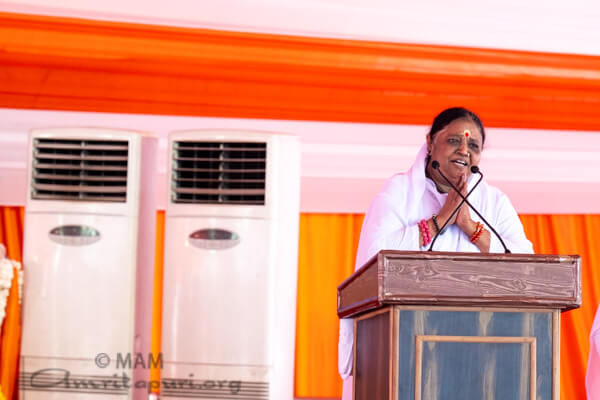
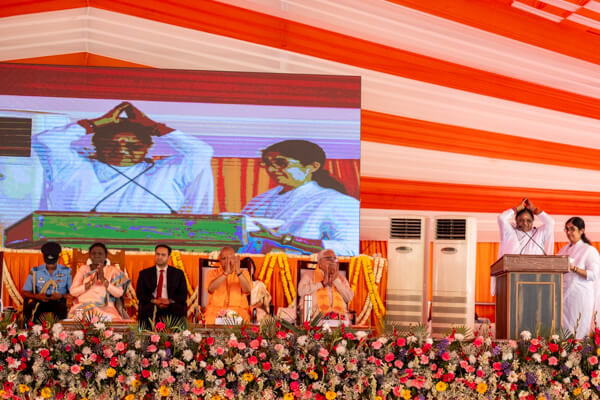
Amma’s address on the occasion of the dedication of the Sri Rāma Rakṣa Yantra
“Amma offers her salutations to all of you who are verily the embodiments of Pure Love and the Supreme Self. My praṇāms at the Lotus Feet of Śrī Rāmacandra—the perfect upholder of dharmic conduct—and to this sacred land sanctified by his footsteps.
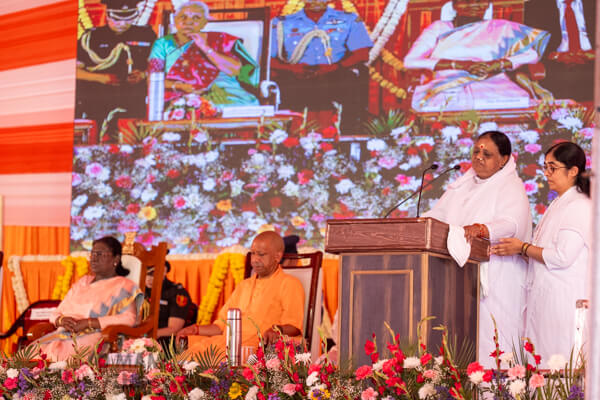
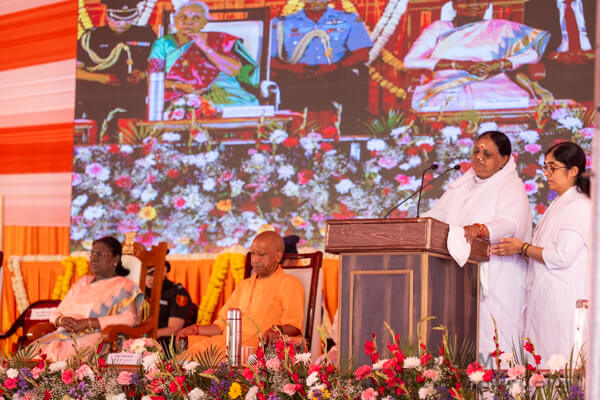
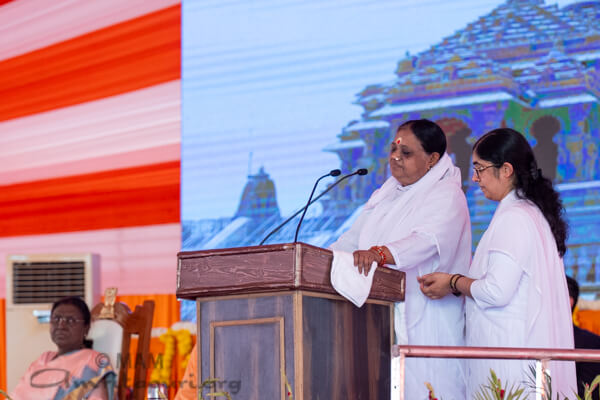
Honourable President of India, Smt. Draupadi Murmu; Honourable Governor of Uttar Pradesh, Smt. Anandiben Patel; Honourable Chief Minister of Uttar Pradesh, Sri Yogi Adityanath; respected sannyāsīs and dignitaries in the audience, noble souls who have dedicated their lives to reclaim the Rāma-janma-bhūmi, and dear devotees…
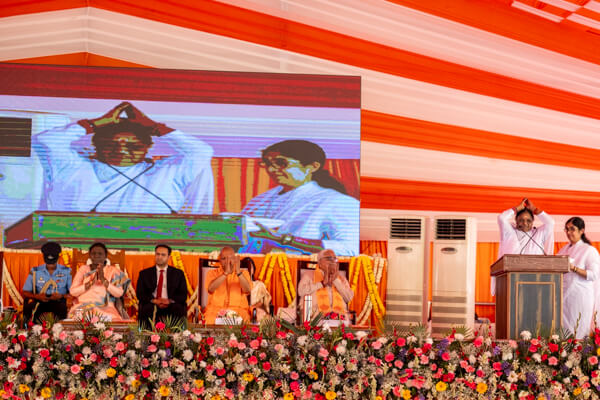
Today is Chaitra Navarātri, the day that marks the start of the Hindu New Year. Moreover, this day also marks the beginning of the Rāma-navamī celebrations. Amma is extremely happy to have had the opportunity to participate in this auspicious ceremony taking place at the sacred Śrī Rāma-janma-bhūmi.
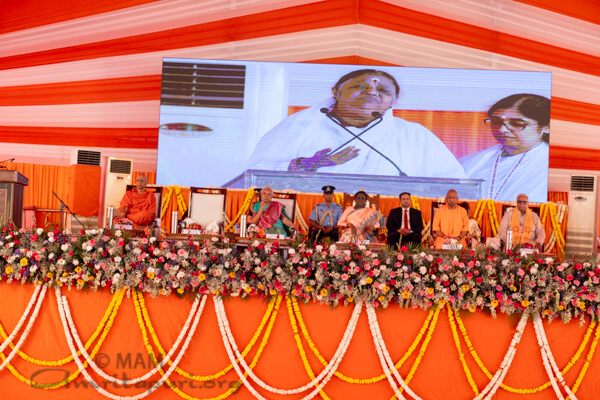
and Chief Minister of Uttar Pradesh on the stage
The Rāma Temple in Ayodhyā is a symbol of a new sunrise for Sanātana Dharma. This great temple is the realisation of centuries of prayers and tireless effort involving tremendous sacrifice. This is also an occasion to reverentially remember the millions who dedicated their lives to this great yajña — those who offered their lives in sacrifice and those who served with selfless dedication.
Śrī Rāmacandra symbolises the epitome of the ṛṣi-lineage of the great culture of Bhārat. Śrī Rāma is synonymous with dharma. He embodies purity of character. He stands as the eternal model of dignity and nobility in character to the world.
Śrī Rāma and Śrī Kṛṣṇa did not merely accept fate as it was. In every circumstance of life, they acted in accordance with dharma. They demonstrated the greatness of human effort.
Bhārat is the land that has conveyed the message of all-embracing unity to the world. Śrī Rāma is the ever-radiant symbol of that immortal culture. May the life and remembrance of Śrī Rāma always sanctify human hearts.
In these times, when values are gradually eroding, the Rāmāyaṇa and the life of Śrī Rāma awaken in us a sense of dharma, inner strength and selflessness in our actions.
What is the distinctive feature of dharma? Dharma stands beyond all external differences and witnesses and accepts everything. This broad vision is what sets Sanātana Dharma apart from all others. That perspective harbours no hostility, vengefulness, sorrow or anger. There, one sees only goodness in everyone and in everything.
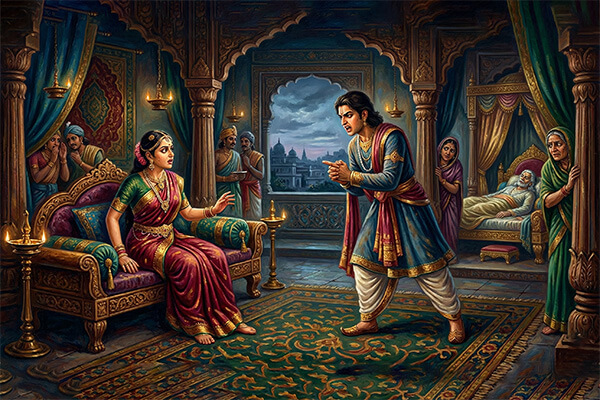
Bharata finds the fault
Look at the attitude of Bharata. His mother, Kaikeyī, had diabolically plotted Rāma’s exile to the forest so that her own son could ascend the throne. But when he arrives back in Ayodhyā, Bharata is furious to learn of his mother’s plan. But soon, he begins to think, “Who is the real offender here?”
“Is it Manthara? Manthara is just a maid; she will only try to please her mistress. She will try to get her mistress’ attention. She cannot be blamed.”
“Is it my father Dasaratha? How could he be so blind?” Then, Bharata thought, “My father was bound by the promise he’d made to his wife when she saved him from danger. How can I blame him?”
“Is it my mother, Kaikeyi. How could she be so cruel?” Then Bharata thought, “For a mother’s attachment to her son can make her do anything, and she may have wished for him to become the king. It is a mother’s desire, and I cannot find fault with her for that.”
Bharata thought again, “The kingdom and title were meant for Rāma alone. They were rightfully his. Why did he not assume rulership? Why did he abdicate and leave for the forest?” Then he tells himself, “My dear brother had only one intent—to obey the words of our father. Suppose the father is in debt and is not able to pay it back during his life-time, is it not the duty of the son to pay it back? My brother just did that.”
In this way, one by one, Bharata clears each person of blame. Finally, he says to himself, “None of them are guilty. If I had been here in the kingdom, none of this would have happened. The only person really to blame is myself. I am the only one who needs to change.”
As long as one believes that others are the cause of one’s problems, one will not experience freedom, happiness or true peace. One must have the courage to take personal responsibility for the events and circumstances that arise in life. Only then can there be freedom, happiness and the resolution of problems.
What is Rama Rajya?
When Bharata goes to meet Śrī Rāma in the forest, with the hope of getting him back to Ayodhyā, there is an interesting conversation between them that comes to Amma’s mind.
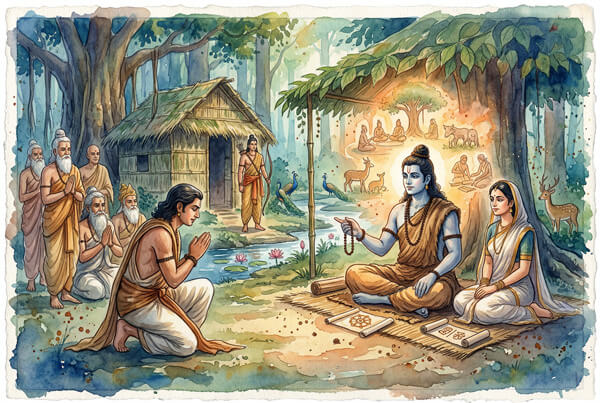
With love, Rāma enquires about the well-being of his subjects, including Kaikeyī, who was the reason for his exile. The foundational principles of the noble vision of “Rāma Rājya” are based on the questions that he then asks Bharata.
Śrī Rama asks Bharata, “Are you giving due respect and adoration to the knowledgeable ones, the forefathers, servants, preceptors, those who are equal to your father and the elderly? Have you kept men of courage and wisdom who have gained control over their senses as your ministers? Young one, I hope you’re not enslaved by sleep.”
Śrī Rama continues, “Are you working with energy, enthusiasm and awareness? As night ends, do you reflect upon all that has to be done during the day? I trust you don’t make independent decisions on matters of governance. At the same time, I hope you take the counsel of only a few people, so that your decisions don’t become the talk of the town. I hope you are prompt in starting the small enterprises leading to steady and sustainable development.”
Śrī Rama continues, “I hope the other kings know of your actions only after they have been achieved or are on the verge of completion. I hope you accept the views of one intelligent, wise and knowledgeable person over those of a thousand unintelligent ones. Remember, even if you have thousands of men, they will not fittingly support you if they have no wisdom and discernment.”
“Have you given due honour and respect to the young, the battle strategists, those who have proved their mettle and the valiant ones?”
Rāma asks Bharata, “Are you giving the army their rations and salary on time? I hope you do not delay in giving them what is their due. My brother, if they do not receive their food and salary on time, they will become angry with the rulers and wreak vengeance.”
“I hope you are performing all the traditional pūjās and rituals and are celebrating the festivals without fail.”
“You must see that the fields are ploughed well and seeds sown on time. You should give special encouragement and consideration to the farmers. In truth, we should prostrate before our villages. It is the villages that provide the food to satiate our hunger. It is the food produced in the villages that keeps us alive. So, they should be supported well.”
“I hope you protect the ponds, rivers, streams, canals and cattle well.”
“Are you providing whatever is needed by small businessmen and big entrepreneurs? I hope you are giving them adequate protection.”
“I hope there are safeguards for women and children in the kingdom.”
“Are you protecting the trees and forests?”
“I hope the inflow of money is much greater than the expenses incurred. Are you spending the money in the treasury wisely and for the upkeep of goodness?”
“Do you interact well with your subjects and try to understand their problems?”
“Did you establish good relations with the neighbouring kingdoms?”
In the questions that Śrī Rāma asks Bharata, the answers themselves are implied. Through them, Rāma gently conveys the message, “Dear brother, if you have not done these already, please do them now.”
These teachings form the very foundation of Rāma Rajya—the ideal governance. Śrī Rāma’s questions and the answers they suggest are not meant only for the Treta Yuga; they continue to offer guidance even today, and for all times, to all nations and their rulers.
These teachings form the very foundation of Rāma Rajya. Śrī Rāma’s questions and the answers continue to offer guidance even today, and for all times, to all nations and their rulers.
Amma is very happy that our Prime Minister Shri Narendra Modi ji is doing his best to implement all these initiatives mentioned by Lord Rama to Bharata.
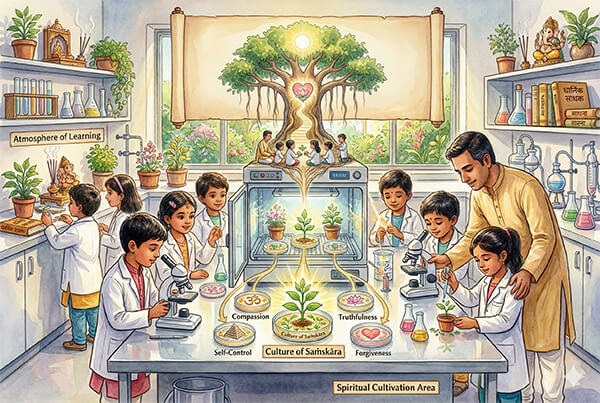
Ashram, a cultural lab
The literal translation for the word saṁskāra is “culture.” In a laboratory, a culture refers to a small specimen of bacteria given the proper environment in which to grow. We all know what this kind of “culture” means. The lab conditions are maintained favourable for the culture to grow and flourish. In a similar manner, instilling saṁskāra—spiritual culture—in children at a tender age paves the path to internal growth. To make this spiritual culture flourish within our children, a conducive atmosphere should be created in our homes and schools.
One may say that our genes determine the actions we perform. But circumstances have also an influence on how a person acts. Amma feels that genes require input from the environment to work properly.
Nowadays the younger generation spends more time on the internet. Culture is something that helps one to go from the ‘internet’ to the ‘inner-net’. The Sri Rama Yantra installed today represents knowledge that will help one to delve within and connect to the inner-net.
Rama could have at least said ‘sorry’ to Sita
Children from 150 countries live in Amma’s āśram. They are young and speak many different languages. Yet, given the opportunity to grow up in the āśram environment, they have naturally absorbed its values. This has helped them face life with clarity—making them able to discern right from wrong. Amma will narrate a few incidents:
One young girl from the West asked Amma, “Wasn’t it cruel on Lord Rāma’s part to leave Sītā in the forest when she was pregnant? He could have at least said, ‘Sorry,’ to her.”
Amma told her “Rāma was a king. For a dharmic king, kingdom comes first. His family comes only later. He will always maintain the rājya-dharma—righteous rule over a kingdom. Only when the kingdom is safe can the citizens live safely. Lord Rāma was also the commander of his forces. When a war breaks out, the dharma of the army commander will be to be at the warfront defending his kingdom. He cannot be sitting home at that time, hugging his family. When many ask questions about Sri Rama leaving Sita in the forest, they forget the tremendous effort Lord Rama put in to get Sita back after she was abducted by Ravana.
Also, as per Indian culture, when a woman is pregnant, she should listen to the chanting of the names of the Lord and his glories so that her mind is in a peaceful and happy state. Moreover, the child in the womb is also benefitted by the spiritual vibrations. So, Rāma created this situation so that Sītā could spend her pregnancy in the spiritually charged atmosphere of the Vālmīki Āśram.”
Three days later, the little girl who asked the question, was giving a talk. In that she said, “My father is in France. I live in Amritapuri with my mother, as a result of which I have the opportunity to study texts like the Rāmāyaṇam and the Gītā. This is like when Śrī Rāma sent his wife and child to live in Vālmīki’s Āśram.”
Bhīṣma was stuck in the past
Another child asked, “Amma, wasn’t Bhīṣma wrong when he stood silent as Draupadī was being disrobed in the court of the Kauravas?”
Amma said, “We have important lessons to learn from all these characters in the Mahābhārata. Bhīṣma was stuck in the past. He gave his word to his father that he would always remain a celibate and serve whoever was sitting on the throne in the Kuru lineage with unwavering loyalty. But he failed to clearly see what was happening in the present moment. The lesson for us is that we should not be stuck in the past. We have to be in the present moment. Actions done living in the present will automatically make the future secure.”
I feel happy whenever I think about giving
Since these kids are exposed to these teachings at an early age, they develop compassion for their fellow beings.
For example, there is a child who wanted her parents to buy a particular doll for her, and she cried for days to force them to buy it. But once she got it, a few days later she gave it to another little girl on her birthday.
Seeing this, Amma called her and asked, “Why did you give your favourite doll away?”
“That girl doesn’t have a mother,” the little one replied. “She might also want a doll like this, but who will buy it for her? So I gave her mine.”
“You cried and begged your mother to get this doll for you, and you just received it a few days ago. Didn’t you feel sad giving it away?” Amma asked.
“No,” she replied. “I actually felt much happier than when I got it! And I feel happy whenever I think about giving it to her.”
When children imbibe the values from our scriptures, they are able to empathise with others who may be suffering.
Just as Lava and Kuśa, the sons of Śrī Rāma, sang the Rāmāyaṇam and thereby created the circumstances that brought Rāma back into their lives, our children too should be able to discover the Divine within themselves and share it with the world. For this, we must firmly instil and nurture spiritual values in them.
Beautiful flowers getting infested by bugs
Today, as values continue to decline, the growing use of intoxicants among youth and children is something we must fear even more than war. It is like buds that could have blossomed into beautiful flowers getting infested by bugs. Those meant to become responsible contributors to their families and the nation are instead being consumed by addiction. The only remedy for this is to nurture strong values and character from a young age.
Man has learned to fly like a bird and swim like a fish but has forgotten how to walk and live like a human being. Even an earthworm mates, procreates and dies. Having attained a human life, are we doing anything different? At least earthworms contribute to soil fertility. On the other hand, when human beings die, the body is treated with chemicals. As such, if we are buried, we become poisonous to the soil. If we are cremated, toxic fumes are released into the atmosphere. While living too, we exploit and destroy Nature. What can we offer to the world with this precious gift of human birth?
Wherever a turtle crawls, it leaves a trail in the sand. In a similar way, we must try to leave a mark—good memories—before we exit the world.
Creator & Creation are not two, but one
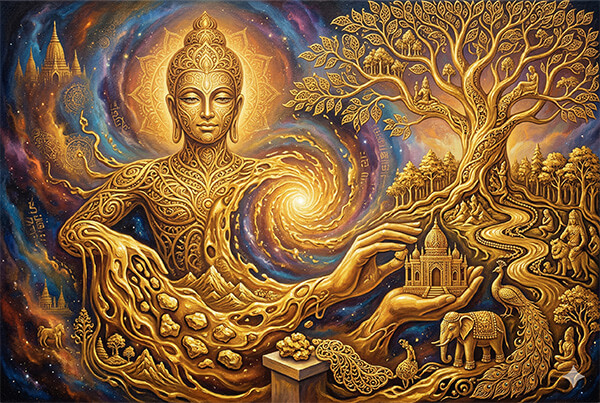
In Sanatana Dharma, creator & creation are not two, but one. It is the creator who has become the whole of creation. Just like gold and gold ornaments are not two, but one. Let us put in efforts to translate the Upanishadic dictum of “Ishavasyamidam Sarvam” (Everything is permeated by the Consciousness Principle alone) into our experience.
Even an act as simple as yawning requires the grace of the divine energy. This is not under our control. Without that grace, we may find we can open our mouth to yawn but are then unable to close it again! So, whatever it is we are doing, we should remain aware of the divine power functioning behind all of our actions. Let’s develop an attitude of surrender before that Supreme Power.
With the prayer for divine grace to be upon one and all, Amma offers these words to the Paramātmā.”