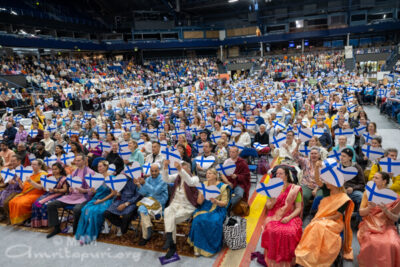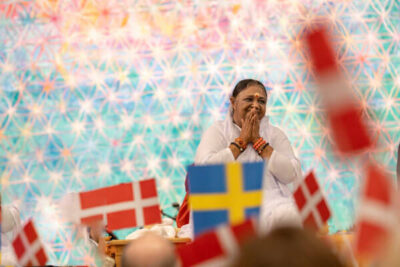
28 Oct, Espoo, Helsinki, Finland – Europe Yatra 2025
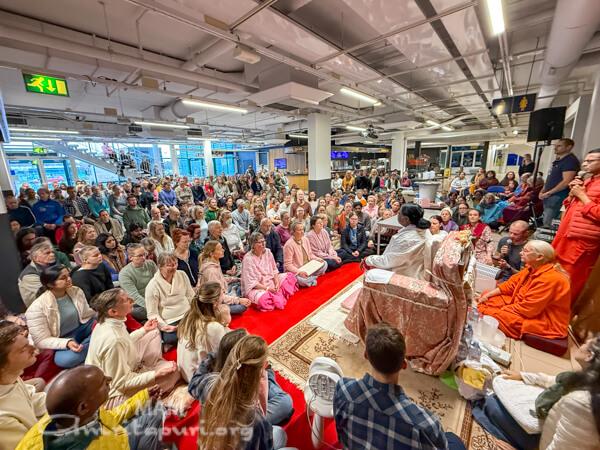
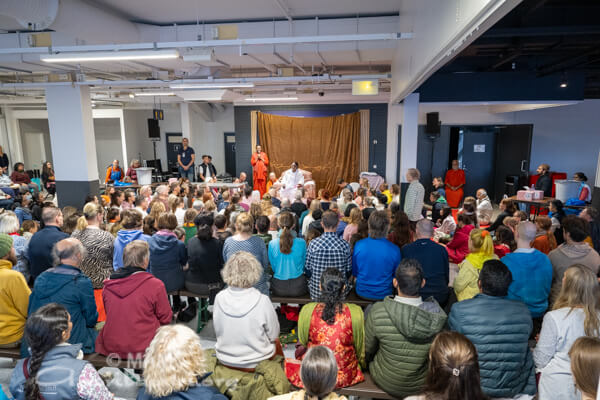
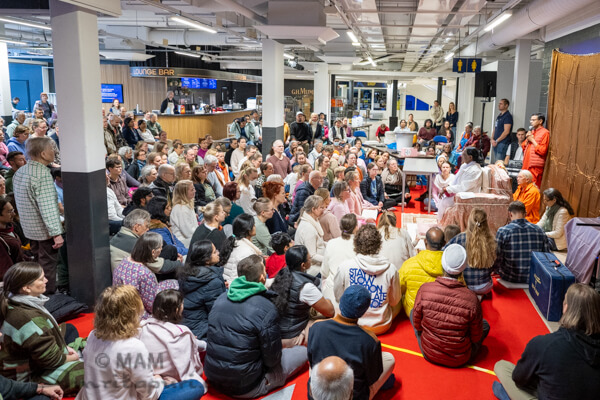
The day after the public programs, Amma met 250-odd the local volunteer children one last time before departing. All gathered near the bar area of the ice hockey stadium, crowded around Amma. She asked them to say something, share a joke, or tell stories.
A compost “Vedanta”
One volunteer, Gaurang, shared a story:
“About fifteen years ago, I was doing seva in the compost area in Amritapuri with a man of rather intense temperament. He loved long periods of silence, constantly listening to Vedanta talks on YouTube.
One day, while we were mixing cow dung and bio-waste, he began tossing cow dung across the table. Each time, it splattered all over me.
I asked, ‘Could you please ok stop?’—but he continued.
After a few requests, he finally asked in a ‘Vedantic’ tone, ‘Who is the one that gets angry?’
I lost my patience and replied, ‘I don’t know who it is—but I do know someone on the other side of this table is about to get punched!’”
Amma laughed: “This is modern Vedanta! People read a great deal, but they don’t practice what they learn.”
Advaita must be lived
Amma added, “With true understanding of Vedanta, we must see oneness in everything. When our left hand is hurt, the right hand instinctively soothes it. Or if our finger accidentally pokes our eye, we don’t punish the finger. Eyes and finger—both are ours. When we have this awareness, compassion arises naturally—this is real Advaita.”
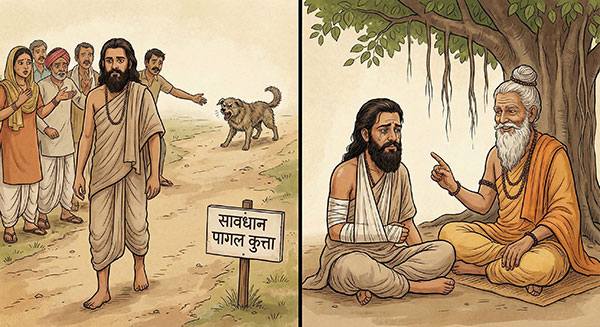
Amma recalled a story:
A sadhak once walked through an area where a mad dog roamed free. People warned him, “Don’t go there—there’s a mad dog!”
But the sadhak ignored them and continued walking. The dog ran up and bit him.
Crying loudly, he went to his Guru.
The Guru asked, “Why didn’t you listen when people warned you about the dog?”
“But, Master, you have taught us that everything is Brahman,” replied the disciple.
The Guru smiled and said,
“If you thought the dog was Brahman, why didn’t you think that the people warning you were also Brahman?”
Amma warned, “We need discrimination—the ability to discern and apply wisdom appropriately—if we wish to truly live by these teachings. Intellectual understanding alone is not enough; we must translate that into action.”
“Writing the word honey on paper and licking it won’t give any sweetness,” Amma said. “Similarly, Advaita must be practiced, not merely repeat ‘Aham Brahmasmi’ like a tape recorder. The ancient rishis of India performed tapas for years to realize the Truth; only then did they declare ‘I am the Self’ or ‘All is Brahman.’ We too must make an effort.”
“Advaita is the ultimate truth, a blossomed flower. Instead of repeating ‘I am the flower’ you should become the flower, a flower, which gives beauty and fragrance. Live the principle.”
Tapasvi a transformer
“If we are like street lamps, the tapasvi—the true practitioner—is like the transformer. Spiritual practice generates tremendous energy and can serve many. ”
On sadhana, Amma reminded: “Mantra japa is one of the easiest methods. Remember to chant the mantra. Chant recalling and reflecting on the purpose.—ōrthu japikkuka, ōrttōrthu japikkuka (ഓർത്ത് ജപിക്കുക. ഓർത്തോർത്ത് ജപിക്കുക) —and do it with awareness. It leads us to our real Self. We may begin with enthusiasm, but the real test is consistency and sustaining it. Like a spider tirelessly spinning its web, keep practicing. Try to keep chanting the mantra wherever you are. We all have time for mantra chanting if we truly wish to use it. Try to repeat your mantra while doing your daily tasks.”
“Our body will perish sooner or later—better to wear it out in performing selfless actions than let it rust in idleness,” Amma said. “We should not become blind to the pain and sorrows of others. Our hearts should expand. Learn to see others’ suffering as your own and be sensible enough to respond at their level of understanding. When you no longer see others as separate, you naturally strive to ease their pain. This is truly Vedanta in action,” Amma explained—the way of practice of Vedanta.
Clapping and laughing
Amma wanted everyone—especially her Finnish children—to laugh. Noticing the crowd’s seriousness during the program, she asked all to clap and laugh aloud. All happily clapped and cheered. It might have lasted for a minute.
Amma continued: “We have only the present moment. Accept life as it comes,” she said. “There’s no point living in constant fear; you cannot lock yourself indoors forever.”
When someone said, “Finnish people keep their happiness inside,” Amma smiled: “Flowers are enjoyed in full bloom, not as tight buds. If emotions are locked away, the number of hospitals and prisons will only increase.”
“If honey is trapped in a rock, no one can enjoy it. When you coo or play with a child, that’s an expression of love; only expressed love is truly felt. When joy fills you, express it—every cell comes alive. Amma knows it may not be the Finnish way, but as Amma’s children, you all try to change. When you give, you receive so much—keep trying!”
Amma then served prasād lunch, sang a few bhajans, and took leave for France—giving the Finnish children a demo version of laughter and a smile lesson forever.
—Sakshi